
In a remarkable achievement for India’s indirect tax ecosystem, Haryana has emerged as the fastest-growing state in terms of Goods and Services Tax (GST) revenue collection during the first quarter of Financial Year 2026-27.
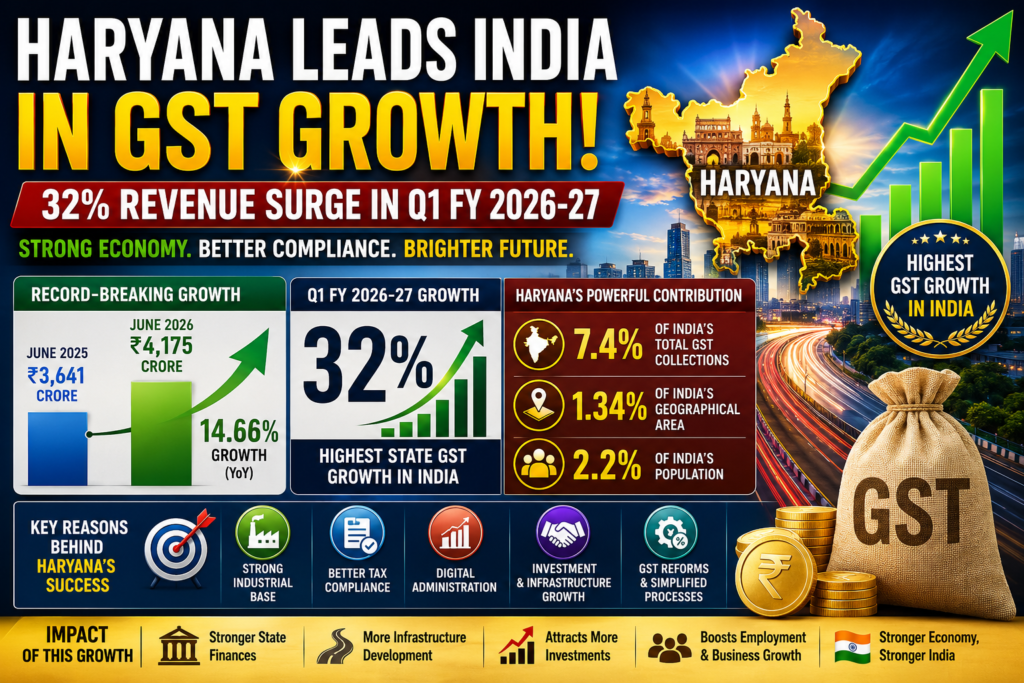
According to official information released during the celebration of the 9th Anniversary of GST implementation on 1 July 2026, Haryana recorded an impressive 32% growth in State GST revenue during Q1 FY 2026-27, substantially exceeding the national average growth rate of approximately 18%.
The development highlights not only Haryana’s economic strength but also demonstrates the continuing maturation of India’s GST regime and the increasing formalisation of economic activities.
The achievement has attracted significant attention among policymakers, tax professionals and industry participants, as Haryana’s performance may serve as a model for other states aiming to improve tax administration and revenue mobilisation.
Haryana’s Outstanding GST Performance
Official data indicates that Haryana collected approximately ₹4,175 crore in GST revenue during June 2026, compared with around ₹3,641 crore during June 2025, representing a growth of nearly 14.66% on a year-on-year basis.
The state reportedly ranked among the top-performing states in terms of monthly GST collections and revenue growth.
Even more remarkable is the long-term trend.
State GST revenue in Haryana has reportedly more than doubled between FY 2018-19 and FY 2024-25, highlighting the state’s sustained economic expansion and improved tax compliance ecosystem.
Despite accounting for only:
- Approximately 1.34% of India’s geographical area, and
- Around 2.2% of the country’s population,
Haryana contributes nearly 7.4% of India’s total GST collections, underscoring its economic significance.
Why Is Haryana Performing So Well?
Several factors appear to have contributed to Haryana’s exceptional GST growth.
1. Strong Industrial and Manufacturing Base
Haryana remains one of India’s major industrial hubs.
The state hosts significant manufacturing activities across sectors such as:
- Automobiles,
- Auto components,
- Electronics,
- Consumer goods,
- Logistics,
- Information technology.
Industrial centres such as Gurugram, Faridabad, Manesar, Panipat and Sonipat continue to drive economic activity and tax collections.
The strong manufacturing ecosystem directly contributes to higher GST revenues.
2. Better Tax Compliance
Over the years, GST administration has increasingly become technology-driven.
The adoption of:
- E-invoicing,
- Data analytics,
- AI-driven monitoring,
- Automated reconciliation systems,
has significantly improved compliance levels.
Haryana appears to have benefited substantially from improved compliance mechanisms and digital tax administration.
3. Economic Formalisation
The GST regime has accelerated the formalisation of businesses.
Increasing numbers of enterprises have shifted towards:
- Proper invoicing,
- Digital accounting,
- Banking transactions,
- Tax registrations.
Formalisation generally leads to improved tax collection efficiency and broader revenue bases.
4. Infrastructure and Investment Growth
Haryana has continued to attract substantial investments due to:
- Excellent connectivity,
- Proximity to the National Capital Region,
- Industrial corridors,
- Logistics infrastructure.
Higher economic activity naturally translates into stronger GST collections.
Role of Recent GST Reforms
Officials have reportedly attributed part of the success to several reforms introduced in recent years.
These include:
GST Rate Rationalisation
Efforts to simplify the tax structure have improved certainty and reduced classification disputes.
Simplified Compliance Measures
Reduction in compliance complexities has encouraged greater participation by businesses.
Removal of Inverted Duty Issues
Addressing inverted duty structures has improved business cash flows in several sectors.
Consumer-Friendly Reforms
Certain reforms relating to essential goods and services have improved overall market efficiency.
Why This Development Matters for India
Haryana’s performance has broader implications for the Indian economy.
1. Strong Indicator of Economic Growth
Higher GST collections generally indicate:
- Strong economic activity,
- Increased consumption,
- Better manufacturing output,
- Higher formal sector participation.
The robust growth suggests that economic activity in several sectors remains healthy.
2. Improvement in Government Finances
Higher GST revenues strengthen fiscal resources available to both the Centre and States.
Additional revenues can support:
- Infrastructure projects,
- Welfare schemes,
- Capital expenditure,
- Social development programmes.
3. Positive Signal for Investors
Strong tax collections are often viewed positively by investors because they reflect:
- Economic resilience,
- Better compliance,
- Higher transparency,
- Strong business activity.
This may further improve investor confidence in the state.
4. Demonstration Effect for Other States
Haryana’s success may encourage other states to adopt similar administrative and compliance strategies.
Improved tax governance and digital administration may become key focus areas across India.
Impact on Businesses
The rise in GST collections could have several implications for businesses.
Positive Impact
Better Infrastructure Spending
Higher revenues may enable increased government spending on infrastructure and industrial development.
Greater Policy Stability
Improved revenue collections reduce fiscal pressures and may support stable taxation policies.
Improved Ease of Doing Business
Successful digital tax administration often encourages further simplification initiatives.
Areas Requiring Caution
Increased Data Analytics and Scrutiny
As revenue administrations increasingly rely on technology and analytics, businesses should expect:
- Greater reconciliation requirements,
- Enhanced compliance monitoring,
- More data-driven assessments.
Maintaining accurate records and proper GST compliance will remain essential.
What Does This Mean for GST 2.0?
The success of states like Haryana may strengthen the case for further GST reforms.
Potential future reforms may include:
- Simplification of tax slabs,
- Faster refund mechanisms,
- Reduction in litigation,
- Greater automation,
- Improved taxpayer services.
The next phase of GST reforms could focus increasingly on balancing revenue growth with ease of compliance.
Challenges Ahead
Despite impressive growth figures, certain challenges remain.
These include:
- Global economic uncertainties,
- Commodity price volatility,
- Potential slowdown in exports,
- Rising compliance complexities for small businesses.
Maintaining high growth rates over the long term may require continuous policy support and administrative improvements.
The Bigger Picture
Nine years after the implementation of GST, India’s indirect tax system continues to evolve.
The exceptional performance of Haryana demonstrates how:
- Economic formalisation,
- Technology adoption,
- Compliance improvements,
- Policy reforms,
can collectively transform revenue administration.
The state’s success story also reinforces the broader narrative that GST has gradually matured into a more stable and efficient tax framework.
Conclusion
Haryana’s achievement of recording the highest GST revenue growth in India at 32% during Q1 FY 2026-27 represents a significant milestone in India’s tax reform journey.
The development reflects not only the state’s economic dynamism but also the growing maturity of India’s GST ecosystem.
Strong compliance, digital transformation, industrial growth and policy reforms appear to have collectively contributed to this impressive performance.
As India moves towards the next phase of GST reforms and discussions surrounding GST 2.0 gather momentum, Haryana’s experience may provide valuable lessons for policymakers and tax administrations across the country.
If similar trends continue across other states, India could witness further strengthening of revenue collections, economic formalisation and long-term fiscal stability.
Reference:
This article is based on official information released during the celebration of the 9th Anniversary of GST implementation on 1 July 2026, including publicly available government statements and data regarding Haryana’s GST performance.
Disclaimer
This article is intended solely for educational, informational and journalistic purposes. The contents are based on publicly available government releases, official statements and tax-related information available at the time of publication. The article does not constitute legal, tax, accounting or professional advice. Readers are advised to refer to official notifications and consult qualified professionals before making any decisions based on the information contained herein. Future policy measures and economic conditions may affect the interpretation and implications of the developments discussed above.