
India’s long-awaited Goods and Services Tax Appellate Tribunal (GSTAT) has finally become operational, offering taxpayers an effective appellate forum under the GST regime. However, even before the system could stabilise, serious concerns have emerged regarding technical issues in the newly launched GSTAT e-filing portal.
In a significant development, the Malad Chamber of Tax Consultants (MCTC) has submitted a representation to the Union Finance Minister seeking an extension of the statutory deadline for filing appeals before the GST Appellate Tribunal under Section 112 of the CGST Act, 2017.
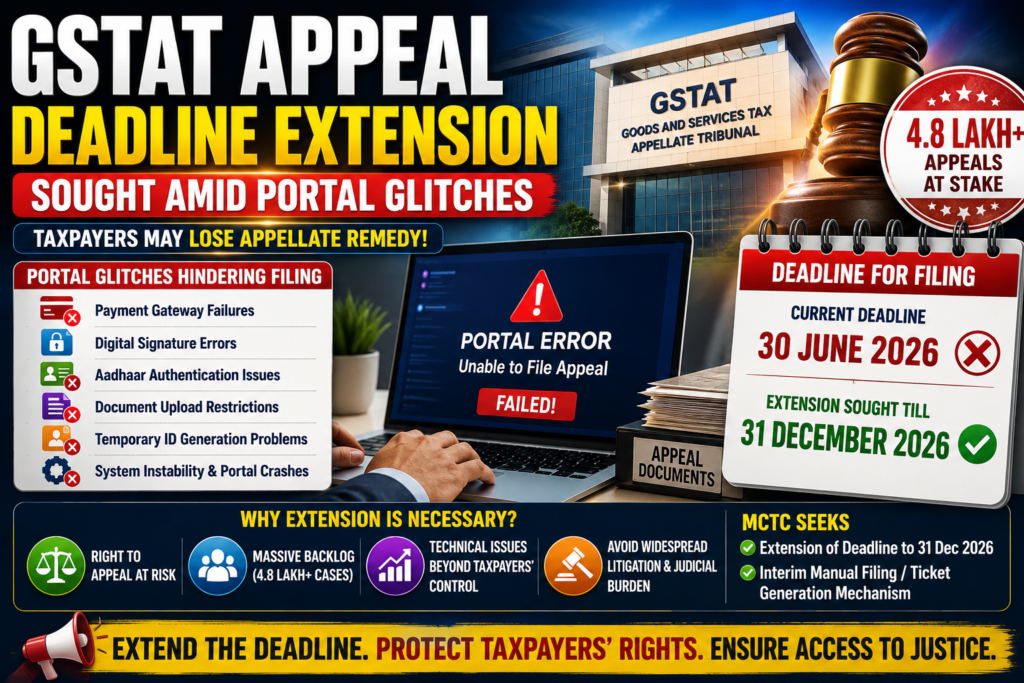
The professional body has requested that the present filing deadline of 30 June 2026 be extended to 31 December 2026, citing widespread portal glitches, technical failures and practical difficulties faced by taxpayers and professionals across the country.
The issue has now become one of the most important procedural challenges under the GST regime and could have major implications for taxpayers, businesses and the judicial system.
Background of the Issue
For several years after the introduction of GST in July 2017, taxpayers faced significant difficulties because the GST Appellate Tribunal had not become operational.
As a result, thousands of appeals remained pending, and taxpayers had limited remedies against orders passed by the First Appellate Authority.
The recent operationalisation of GSTAT was therefore welcomed by taxpayers and professionals alike. However, the launch of the e-filing portal has reportedly been accompanied by numerous technical and procedural issues.
According to MCTC, these issues are making it extremely difficult for taxpayers to file appeals within the prescribed timelines.
Major Portal Issues Reported
The representation reportedly highlights several practical problems in the GSTAT filing system, including:
- Payment gateway failures during appeal fee payment.
- Digital Signature Certificate (DSC) errors.
- Aadhaar authentication failures.
- Restrictions in uploading documents and annexures.
- Temporary ID generation problems.
- Frequent portal crashes and system instability.
- Login and registration issues.
Tax professionals argue that these technical problems are preventing taxpayers from exercising their statutory appellate rights.
Over 4.8 Lakh Appeals May Be Affected
One of the biggest concerns raised by the professional body is the massive backlog of potential appeals.
According to estimates, more than 4.8 lakh cases may eventually come before the GST Appellate Tribunal.
Considering the enormous volume of pending disputes, tax professionals believe that expecting all taxpayers to complete filing within the present deadline despite portal difficulties may not be practically feasible.
The issue is particularly significant for MSMEs and small taxpayers who may not have access to specialised technological support.
Mismatch Between Relaxation Period and Filing Deadline
Another important concern highlighted in the representation is the apparent inconsistency in timelines.
Certain procedural relaxations and scrutiny-related measures have reportedly been extended till 31 December 2026, whereas the deadline for filing GSTAT appeals remains fixed at 30 June 2026.
Professionals argue that maintaining different timelines creates practical difficulties and may prejudice taxpayers who are already struggling with technological challenges.
Why This Issue Is Important
The demand for extension is not merely procedural.
The right to appeal is one of the most important safeguards available to taxpayers against arbitrary assessments and adverse orders.
If taxpayers are unable to file appeals due to technical failures in the government portal, it may effectively amount to denial of justice.
Courts in India have repeatedly held that taxpayers should not suffer adverse consequences because of technological failures that are beyond their control.
Possible Consequences if Extension Is Not Granted
Increase in Writ Petitions
If the deadline is not extended, many taxpayers may be forced to approach various High Courts seeking relief.
This could result in:
- Large-scale writ litigation;
- Increased judicial burden;
- Divergent decisions across states.
Denial of Statutory Appellate Remedy
Failure to provide a workable filing mechanism may deprive taxpayers of their right to challenge adverse orders.
This may raise issues relating to natural justice and access to justice.
Increased Compliance Costs
Businesses may incur substantial legal and professional costs in filing writ petitions and seeking condonation of delay.
The impact could be particularly severe for MSMEs.
Further Delay in Dispute Resolution
Instead of reducing litigation, technical failures may further prolong GST disputes and delay final resolution of tax matters.
Demand for Alternative Filing Mechanisms
Apart from extension of time, the representation reportedly seeks interim solutions such as:
Manual Filing Facility
Allowing taxpayers to file appeals manually until portal issues are fully resolved.
Ticket Generation Mechanism
Providing taxpayers with evidence of unsuccessful filing attempts due to portal glitches.
Such mechanisms have been used previously in the GST ecosystem during technical failures relating to returns and transitional credit filings.
Broader Impact on GST Administration
The GSTAT issue also highlights a larger challenge facing India’s digital tax ecosystem.
India’s tax administration is increasingly dependent upon:
- Technology-driven compliance;
- AI-based monitoring;
- Automated assessments;
- Digital litigation platforms.
While digitalisation has significantly improved transparency and efficiency, it also increases dependence on robust technological infrastructure.
Any system failure can have direct legal consequences for taxpayers.
The present situation therefore underlines the importance of ensuring that digital governance mechanisms are fully operational before enforcing strict statutory deadlines.
Impact on Businesses and Professionals
Tax consultants, Chartered Accountants and businesses are closely monitoring developments.
Many taxpayers are presently concerned regarding:
- Limitation issues;
- Filing deadlines;
- Preservation of appellate rights;
- Documentation requirements.
If relief measures are not introduced, substantial uncertainty may continue in GST litigation.
Possible Government Response
The Government may consider several possible measures:
- Extending the filing deadline till 31 December 2026.
- Introducing temporary manual filing facilities.
- Stabilising and upgrading the GSTAT portal.
- Issuing clarificatory circulars for cases affected by technical failures.
Any such measures would likely reduce litigation and provide much-needed relief to taxpayers.
Conclusion
The representation submitted by the Malad Chamber of Tax Consultants has highlighted a serious procedural concern affecting thousands of taxpayers across India.
With more than 4.8 lakh potential appeals, widespread portal glitches and concerns regarding access to justice, the demand for extension of the GSTAT filing deadline appears to have substantial merit.
Failure to address these issues could lead to increased litigation, additional burden on the judiciary and denial of taxpayers’ statutory rights.
As GST enters its ninth year and the appellate framework finally becomes operational, ensuring smooth access to justice will remain essential for maintaining confidence in India’s indirect tax system.
The coming weeks will therefore be crucial in determining whether the Government introduces relief measures and provides taxpayers with additional time to exercise their appellate remedies.
Reference:
Based on the representation submitted by the Malad Chamber of Tax Consultants (MCTC) to the Union Finance Minister regarding extension of the GSTAT appeal filing deadline under Section 112 of the CGST Act, 2017, and publicly available information relating to operational issues in the GSTAT e-filing portal.
Disclaimer
This article is intended solely for educational, informational and journalistic purposes. The contents are based on publicly available representations and information available as on the date of publication. The article does not constitute legal, tax or professional advice. Readers are advised to refer to official notifications, circulars and government announcements and consult qualified professionals before taking any action based on the information contained herein. Future notifications, extensions or judicial pronouncements may alter the legal position discussed above.