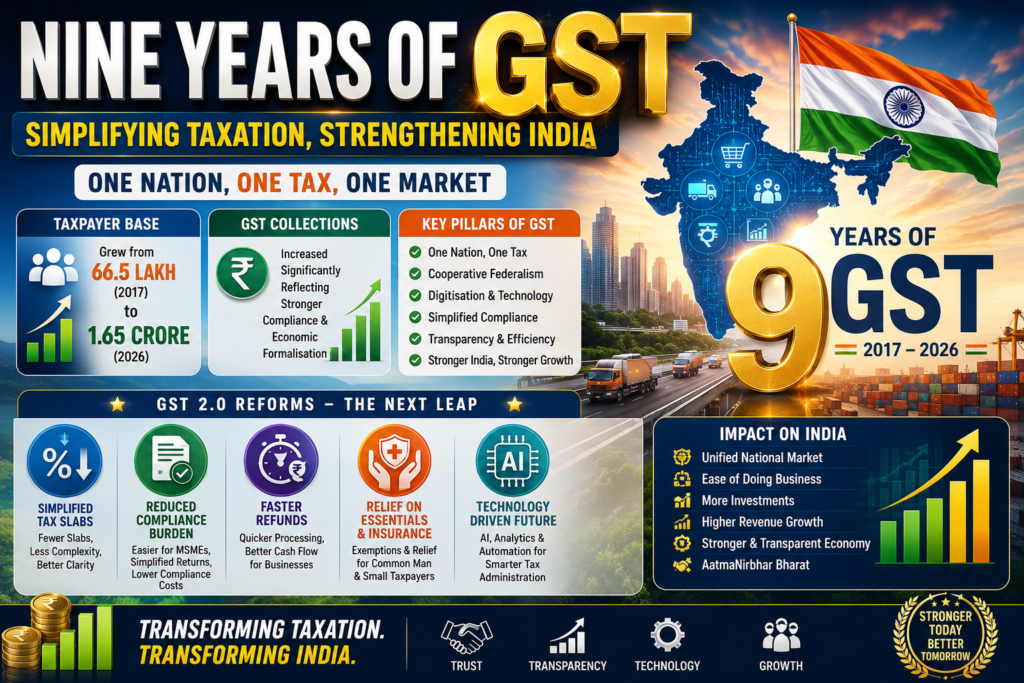

On 1 July 2026, India completed nine years of the Goods and Services Tax (GST), marking an important milestone in one of the country’s biggest economic reforms since Independence.
Introduced on 1 July 2017, GST replaced a complex web of Central and State indirect taxes with a unified taxation framework under the vision of “One Nation, One Tax.”
Over the last nine years, GST has fundamentally changed the way businesses operate, taxes are collected and economic activities are monitored. According to the latest PIB Backgrounder on Nine Years of GST, the tax reform has significantly expanded India’s taxpayer base, improved compliance and accelerated the formalisation of the economy.
As India now moves towards the proposed GST 2.0 reforms, policymakers, businesses and taxpayers are closely watching the next phase of India’s indirect tax journey.
GST at Nine: A Transformation of India’s Tax Landscape
Before GST, India’s indirect tax system was fragmented and complicated.
Businesses had to deal with multiple taxes, including:
- Excise Duty,
- Service Tax,
- VAT,
- Entry Tax,
- Octroi,
- Luxury Tax,
- Central Sales Tax and several local levies.
This often resulted in:
- Cascading taxation,
- Higher compliance costs,
- Multiple registrations,
- Interstate trade barriers.
The implementation of GST sought to remove these inefficiencies by creating a common national market.
Today, nine years later, the impact of GST is clearly visible across various sectors of the economy.
Massive Expansion in Taxpayer Base
One of the most remarkable achievements of GST has been the growth in the number of registered taxpayers.
According to official data, the taxpayer base has increased from approximately 66.5 lakh taxpayers in 2017 to around 1.65 crore taxpayers in 2026.
This remarkable increase reflects:
- Greater business formalisation,
- Improved tax compliance,
- Increased digital registrations,
- Expansion of economic activities.
The widening tax base has also contributed to strengthening government revenues.
GST Collections Reach New Highs
GST collections have witnessed substantial growth since its introduction.
Monthly GST revenues have repeatedly crossed record levels in recent years, reflecting:
- Improved compliance,
- Better analytics,
- Strong economic activity,
- Enhanced monitoring mechanisms.
The growth in collections has strengthened both Central and State finances and provided governments with additional fiscal resources for infrastructure development and welfare expenditure.
Digital Revolution in Tax Administration
Perhaps one of the biggest success stories of GST has been the digital transformation of India’s tax administration.
The introduction of:
- GST Network (GSTN),
- E-way Bills,
- E-invoicing,
- Online registrations,
- Automated return filing systems,
has significantly improved transparency and reduced human interface.
The increasing use of:
- Artificial Intelligence,
- Data analytics,
- Risk-based scrutiny,
- Real-time invoice matching,
has made tax administration more technology-driven than ever before.
This digital ecosystem has helped improve compliance and reduce tax evasion.
Strengthening Cooperative Federalism
GST is unique because it is based upon the principle of cooperative federalism.
The GST Council has become one of the most important institutions in India’s fiscal framework.
Comprising representatives from the Centre and States, the Council has played a critical role in:
- Determining tax rates,
- Issuing policy recommendations,
- Resolving disputes,
- Driving reforms.
The success of GST demonstrates how cooperative policymaking can function effectively in a federal structure.
Formalisation of the Indian Economy
One of the long-term benefits of GST has been the acceleration of economic formalisation.
Businesses increasingly moved towards:
- Proper invoicing,
- Digital accounting,
- Banking transactions,
- Compliance-driven operations.
This has improved transparency in the economy and increased participation in the formal sector.
Formalisation also improves:
- Access to credit,
- Ease of doing business,
- Investor confidence.
Challenges Faced During the GST Journey
Despite its achievements, GST has also faced several challenges.
Businesses have frequently raised concerns regarding:
Multiple Tax Slabs
India continues to operate under multiple GST rates, increasing classification disputes.
Frequent Changes
Numerous amendments and notifications have sometimes created uncertainty.
Refund Delays
Exporters and businesses have occasionally experienced delays in receiving refunds.
Compliance Burden on MSMEs
Small businesses continue to face challenges in return filing and reconciliation requirements.
Litigation
Issues involving Input Tax Credit, place of supply, classification disputes and procedural matters continue to generate litigation.
These challenges have led to growing expectations regarding the next phase of GST reforms.
GST 2.0: What Could Change?
The PIB background document also highlights the possibility of GST 2.0 reforms, which could represent the next major phase of indirect tax transformation.
Although detailed proposals are yet to be formally announced, several reforms are being discussed.
1. Simplification of Tax Slabs
Experts expect rationalisation of GST rates by reducing multiple slabs into a simpler structure.
This may reduce:
- Classification disputes,
- Compliance complexity,
- Litigation.
2. Lower Compliance Burden
MSMEs may receive additional relief through:
- Simplified return filing,
- Reduced procedural requirements,
- Easier reconciliation mechanisms.
3. Faster Refund Processing
Technology-driven processing could further improve refund timelines, benefiting exporters and businesses with accumulated Input Tax Credit.
4. Exemptions and Relief Measures
Discussions continue regarding possible relief in:
- Essential goods,
- Insurance products,
- Healthcare-related services,
- Small taxpayer segments.
5. Greater Use of Artificial Intelligence
Future GST administration is likely to increasingly rely upon:
- AI-driven analytics,
- Automated risk assessment,
- Fraud detection systems,
- Predictive compliance mechanisms.
However, recent judicial developments also indicate that technological adoption must remain balanced with legal safeguards and independent application of mind.
Impact of GST on Indian Businesses
Positive Impact
Easier Interstate Trade
Removal of tax barriers has significantly improved logistics efficiency.
Better Supply Chain Management
Businesses have restructured supply chains to optimise costs.
Increased Transparency
Digital systems have reduced tax leakages.
Improved Revenue Collection
Governments now enjoy more stable revenue streams.
Areas Requiring Further Reforms
Litigation Reduction
A simplified legal framework is essential to reduce disputes.
Better MSME Support
Smaller businesses require additional compliance support.
Stability in Law
Frequent changes should gradually reduce as the GST framework matures.
What Could Be the Economic Impact of GST 2.0?
If implemented effectively, GST 2.0 may have significant positive implications:
Increased Ease of Doing Business
Simpler compliance can improve India’s business environment.
Higher Investment Confidence
Predictable taxation improves investor sentiment.
Greater Tax Compliance
Lower complexity generally leads to better compliance.
Stronger Economic Growth
Improved efficiency can enhance productivity and economic formalisation.
Lower Litigation Costs
Reduced disputes can save significant resources for businesses and government alike.
The Road Ahead
After nine years, GST has undoubtedly emerged as one of India’s most transformative economic reforms.
The system continues to evolve through:
- Technological advancements,
- Policy refinements,
- Judicial interpretations,
- Administrative improvements.
The next phase of reforms will determine whether GST can fully achieve its original objective of creating a simple, transparent and efficient indirect tax regime.
For businesses, taxpayers and policymakers, the coming years may prove even more important than the initial implementation phase.
Conclusion
Nine years after its launch, GST has fundamentally changed India’s taxation landscape.
From expanding the taxpayer base from 66.5 lakh to 1.65 crore taxpayers, improving compliance and driving economic formalisation, GST has significantly strengthened India’s fiscal architecture.
However, challenges relating to complexity, litigation and compliance costs remain.
As discussions around GST 2.0 gather momentum, expectations are rising for a simpler, technology-driven and business-friendly indirect tax framework.
The journey of GST is far from over.
Rather, India now appears to be entering the next chapter of its tax transformation story.
Reference:
This article is based on the PIB Backgrounder on Nine Years of GST: Simplifying Taxation, Strengthening India, published on the completion of nine years of GST implementation in India.
Disclaimer
This article is intended solely for educational, informational and journalistic purposes. The contents are based on publicly available information, government releases and policy discussions relating to GST reforms in India. The article does not constitute legal, tax, accounting or professional advice. Readers are advised to refer to official notifications, circulars and consult qualified professionals before taking any decisions based on the information contained herein. Future reforms and policy changes remain subject to recommendations of the GST Council and legislative approvals.