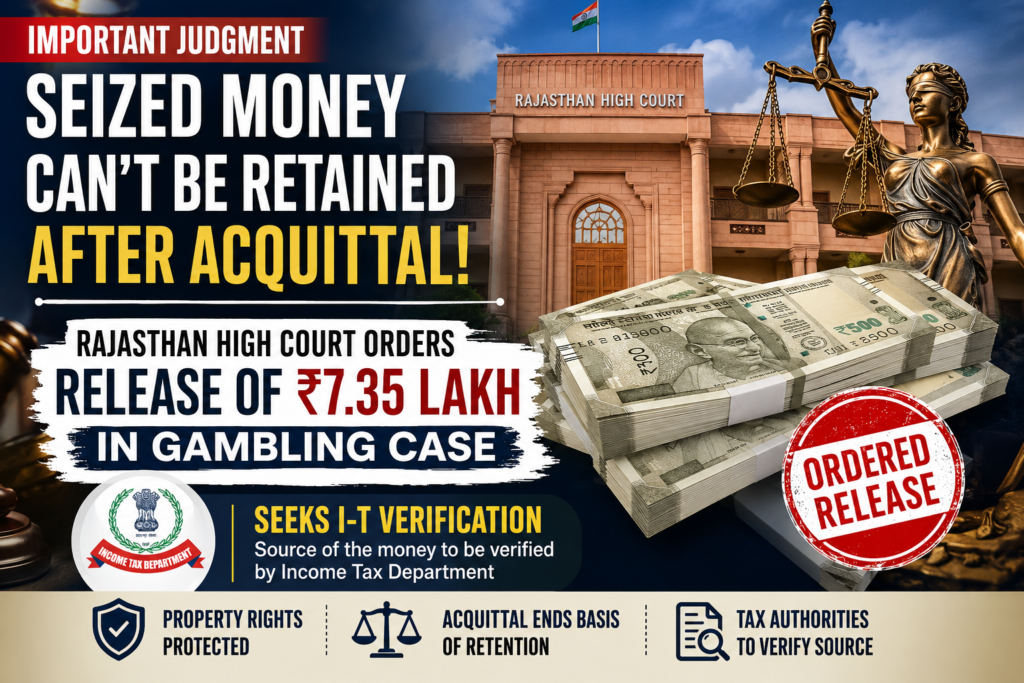

In a significant ruling that could have far-reaching implications for criminal law, taxation, and property rights, the Rajasthan High Court has held that money seized during a criminal investigation cannot continue to remain in government custody once the accused has been acquitted due to withdrawal of prosecution. However, the Court also emphasized that the source of such money must be verified by the Income Tax Department to ensure compliance with tax laws.
The judgment, delivered by Justice Anoop Kumar Dhand in Imran Mansoori vs State of Rajasthan, strikes an important balance between protecting an individual’s property rights and safeguarding the interests of the Revenue authorities.
The decision was reported as 2026 LiveLaw (Raj) 291 and may become an important precedent in cases involving seizure of cash by police authorities.
Background of the Case
The matter originated from an FIR registered against the petitioner under Section 13 of the Rajasthan Public Gambling Ordinance, 1949. During the investigation, the police allegedly recovered and seized:
- Cash amounting to ₹7.35 lakh; and
- One mobile phone.
Subsequently, during the pendency of the criminal proceedings, the Rajasthan Home Department decided to withdraw the prosecution. As a result, the petitioner stood acquitted.
Following acquittal, the petitioner moved an application seeking release of the seized assets.
While the trial court directed release of the mobile phone after erasure of its data, it declined to release the cash amount on the ground that the money was allegedly connected with gambling activities.
The revisional court also refused to grant relief, observing that such money could not be released unless the offence was fully tried and adjudicated.
Aggrieved by these orders, the petitioner approached the Rajasthan High Court.
Rajasthan High Court’s Observations
The High Court categorically disagreed with the reasoning adopted by the lower courts.
Justice Anoop Kumar Dhand observed that once the criminal proceedings had been withdrawn and the petitioner had been acquitted, there remained no legal justification for retaining the seized cash in the government treasury.
The Court observed that:
“Once the petitioner has been acquitted on the basis of withdrawal of the criminal case, there was no reason or occasion to retain the seized amount in the Treasury or Government Fund.”
The Court held that the observations made by the revisional court were contrary to the procedure established by law and could not be sustained.
Income Tax Verification Directed
Although the Court ordered release of the money, it introduced an important safeguard.
The petitioner was directed to disclose the source of the ₹7.35 lakh. The details furnished by him are to be verified by the Income Tax Department.
The Court further clarified that if the explanation regarding the source of funds is found unsatisfactory, the Income Tax authorities shall be at liberty to initiate proceedings in accordance with law.
This aspect of the judgment is particularly important from a taxation perspective because acquittal in a criminal case does not automatically validate the legitimacy or tax compliance of seized money.
In other words:
Criminal acquittal and tax compliance are two separate legal issues.
A person may be acquitted in a criminal case, yet still be required to explain the source of cash under the provisions of the Income-tax Act, 1961.
Legal Significance of the Judgment
The ruling reinforces an important constitutional principle:
1. Property Cannot Be Retained Without Authority of Law
Article 300A of the Constitution provides that no person shall be deprived of his property except by authority of law.
Once criminal proceedings cease to exist, continued retention of seized money may amount to arbitrary deprivation of property rights.
2. Acquittal Removes the Basis of Seizure
The seizure was originally justified only because criminal proceedings were pending.
Once the prosecution itself was withdrawn and the accused stood acquitted, the legal foundation for retaining the money substantially disappeared.
3. Tax Authorities Retain Independent Powers
The High Court carefully ensured that its order does not prevent the Income Tax Department from examining:
- Source of funds;
- Taxability of unexplained money;
- Possible proceedings under Sections 68, 69A or other relevant provisions of the Income-tax Act.
Therefore, the judgment protects both individual rights and the interests of the Revenue.
Similar Judicial Approach in Earlier Cases
Indian courts have consistently held that seized assets should not remain in custody indefinitely.
In earlier judgments, courts have emphasized that valuable articles and currency should not unnecessarily remain with investigating agencies for prolonged periods. The Supreme Court and various High Courts have repeatedly directed prompt disposal or release of seized property subject to appropriate safeguards.
Likewise, judicial precedents under the Income-tax Act also recognize that authorities cannot retain seized assets indefinitely unless supported by statutory provisions and pending tax liabilities.
Tax Implications for Taxpayers and Businesses
The judgment carries important lessons for taxpayers, businessmen and professionals.
Documentation of Cash Holdings Is Essential
Individuals holding substantial cash should maintain adequate documentary evidence regarding:
- Business withdrawals;
- Sale proceeds;
- Agricultural income;
- Gifts;
- Loan receipts;
- Past savings;
- Bank withdrawals.
Failure to establish the source may invite tax proceedings even if criminal allegations fail.
Criminal Proceedings and Tax Proceedings Are Independent
Taxpayers should understand that:
- Acquittal in a criminal matter does not automatically provide immunity from tax scrutiny.
- Similarly, tax additions do not necessarily establish criminal guilt.
Both proceedings operate in different legal domains and have different standards of proof.
Wider Implications of the Judgment
The Rajasthan High Court’s ruling may influence future cases involving:
- Gambling-related seizures;
- Cash recoveries during police raids;
- Withdrawal of prosecution by the State;
- Release of property after acquittal;
- Parallel action by tax authorities.
The judgment sends a clear message that the State cannot indefinitely hold private property once the criminal basis for such retention disappears.
At the same time, it also reinforces the growing judicial trend of encouraging inter-departmental coordination between criminal authorities and tax authorities to verify suspicious cash transactions.
Conclusion
The Rajasthan High Court’s decision in Imran Mansoori vs State of Rajasthan represents an important reaffirmation of property rights and procedural fairness.
The Court rightly held that once an accused has been acquitted following withdrawal of prosecution, seized money cannot continue to remain in government custody merely on suspicion.
However, by directing Income Tax verification of the source of funds, the Court ensured that unexplained money does not escape scrutiny under tax laws.
The ruling therefore creates a balanced legal framework—protecting citizens from arbitrary retention of property while simultaneously preserving the statutory powers of tax authorities to investigate unexplained cash holdings.
Reference:
- Imran Mansoori vs State of Rajasthan, 2026 LiveLaw (Raj) 291.
- Rajasthan High Court Judgment dated July 2026.
Disclaimer
The information contained in this article is intended solely for educational, informational and journalistic purposes and should not be construed as legal, taxation, financial or professional advice. Readers are advised to consult qualified legal practitioners, chartered accountants or tax professionals before taking any action based on the contents of this article. The views expressed herein are based on publicly available judicial records and media reports as on the date of publication. www.smeaccountant.in and the author shall not be responsible for any loss or liability arising from reliance on this article.