Prasenjit Bhowmik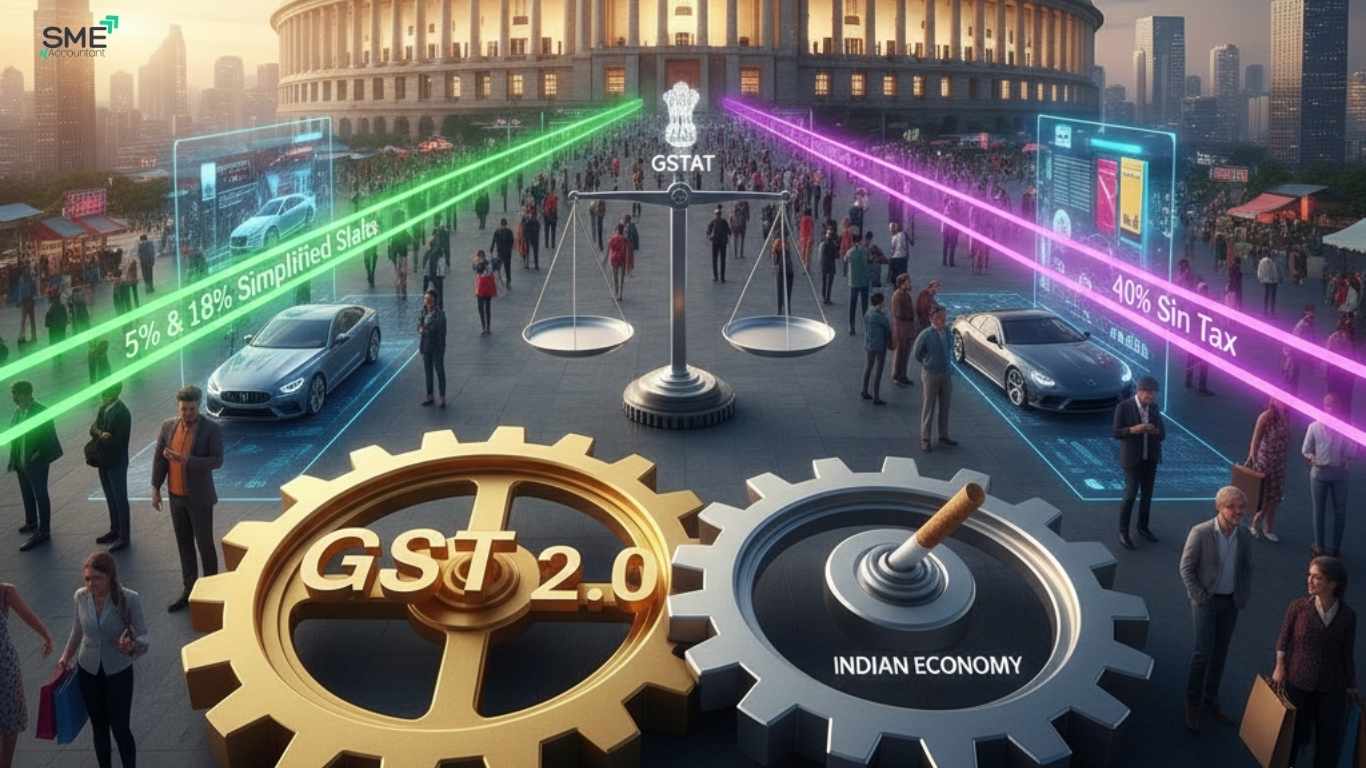
The Goods and Services Tax (GST) in India has undergone its most significant transformation since its inception in 2017. Following the 56th GST Council meeting, the government rolled out GST 2.0, effective from September 22, 2025, introducing a simplified two-tier rate structure, a new 40% “sin tax” for luxury and harmful goods, and stricter compliance measures. As of early 2026, businesses, consumers, and tax professionals are adapting to this overhaul, which aims to streamline taxation, reduce litigation, and improve transparency.
This article provides a comprehensive overview of the key GST updates in 2026, their impact on businesses and consumers, and compliance requirements under the new regime.
📌 Key Highlights of GST 2.0
1. Simplified Rate Structure
- The earlier four-tier structure (5%, 12%, 18%, 28%) has been rationalized into two slabs: 5% and 18%.
- Daily essentials, food items, and basic services now fall under the 5% bracket, reducing the burden on households.
- Electronics, consumer durables, and most services have shifted to the 18% slab, creating uniformity and reducing classification disputes.
- Nearly 90% of items previously taxed at 28% have been moved to 18%, benefiting industries such as automobiles, appliances, and entertainment.
2. Introduction of 40% “Sin Tax”
- A new 40% GST rate applies to:
- Luxury automobiles
- Tobacco products
- Pan masala
- High-end luxury goods
- This move aligns with global practices of imposing higher taxes on products considered harmful or non-essential.
3. Stricter Compliance (January 2026 Onwards)
- The GST portal now validates Input Tax Credit (ITC) strictly against the Electronic Credit Ledger before allowing filing of GSTR-3B.
- This ensures that businesses cannot claim ITC beyond what is reflected in their ledger, reducing fraudulent claims.
4. Mandatory Multi-Factor Authentication (MFA)
- To enhance security, MFA is now compulsory for all taxpayers logging into the GST portal.
- This measure protects sensitive financial data and prevents unauthorized access.
5. Launch of GSTAT (Goods and Services Tax Appellate Tribunal)
- The long-awaited GSTAT has become functional, providing a dedicated platform for faster dispute resolution.
- Businesses can now expect quicker judgments on tax-related appeals, reducing the backlog in High Courts.
🔎 Impact on Businesses
Positive Outcomes
- Reduced Tax Burden: Many goods and services now fall under the 5% slab, lowering costs for consumers and boosting demand.
- Simplified Classification: With fewer slabs, businesses face less confusion in determining applicable rates.
- Faster Dispute Resolution: GSTAT ensures quicker resolution of tax disputes, improving ease of doing business.
Challenges Ahead
- Compliance Pressure: Stricter ITC validation requires businesses to maintain accurate records and reconcile invoices regularly.
- Technology Adaptation: Mandatory MFA and portal changes demand updated systems and training for staff.
- Luxury Sector Impact: The 40% sin tax may reduce demand for high-end automobiles and luxury goods.
📊 Sector-Wise Analysis
| Sector | Previous Rate | New Rate (GST 2.0) | Impact |
|---|---|---|---|
| Food & Essentials | 12% | 5% | Lower household expenses |
| Electronics | 18% | 18% (unchanged) | Stable pricing |
| Automobiles | 28% | 18% (most models) | Boost in sales |
| Luxury Cars | 28% | 40% | Higher costs |
| Tobacco & Pan Masala | 28% | 40% | Discourages consumption |
| Services (general) | 18% | 18% | Simplified compliance |
🛠 Compliance Requirements Under GST 2.0
- Invoice Matching: Businesses must ensure invoices uploaded by suppliers match with their ITC claims.
- Ledger Reconciliation: ITC can only be claimed if reflected in the Electronic Credit Ledger.
- Secure Login: MFA is mandatory, requiring OTPs or authentication apps.
- Timely Filing: Delays in filing GSTR-3B may result in penalties and denial of ITC.
🌍 Broader Economic Implications
- Consumer-Friendly: Lower rates on essentials and electronics increase affordability.
- Revenue Neutrality: The government expects higher compliance to offset reduced rates.
- Luxury Market Slowdown: The 40% sin tax may shift consumer preferences toward mid-range products.
- Digital Transformation: The GST portal’s enhanced security and validation mechanisms push businesses toward digital compliance.
✅ Conclusion
The implementation of GST 2.0 marks a turning point in India’s indirect tax regime. By simplifying rates, introducing stricter compliance, and launching GSTAT, the government aims to make GST more transparent, efficient, and business-friendly. While challenges remain in adapting to new compliance norms, the long-term benefits of reduced litigation, lower consumer costs, and improved ease of doing business are expected to outweigh the initial hurdles.
📢 Disclaimer
This article has been prepared based on official updates released by the Government of India and GST Council notifications. The content is intended for informational purposes only. While every effort has been made to ensure accuracy, we are not responsible for any discrepancies, mismatches, or misinterpretations. Readers are advised to consult official government sources or a qualified tax professional before making business or financial decisions.